Data use

Data from the GBIF network is used in scientific studies published in peer-reviewed journals at a rate of more than six papers every day. Review highlights from the most recent publications drawn from the Secretariat’s ongoing literature tracking programme or check out the comprehensive literature database, which comprises thousands of entries from scientific literature that cite the use of GBIF-mediated data.
Based on their scientific impact, relevance and uniqueness as well as diversity in taxonomy and geography, we select and feature a handful of papers every month. These are later compiled into a printed publication—the Science Review, our annual compilation of scientific articles—partial but instructive—enhanced and supported by free and open data that the GBIF network of members and publishers make available.
The applicability of free and open biodiversity data spans beyond academia, as GBIF-mediated data is also used to inform decision-making and policy—ranging from documents produced by local and national agencies—to extinction risk assessments for thousands of species on the IUCN Red List of Threatened Species— and comprehensive reports by large-scale intergovernmental and convention-based bodies—such as the Intergovernmental Panel on Climate Change (IPCC) and the the Intergovernmental Science-Policy Platform on Biodiversity and Ecosystem Services (IPBES).
Featured examples of data use in research


Hot off the scientific press

Detecting patches of invasive shrubs using high-density airborne LiDAR data and spectral imagery
Choi et al.
Urban Forestry & Urban Greening
31 May 2025

Climate change increases public health risks from Tityus scorpion stings in Brazil
Barroso et al.
Toxicon
30 Apr 2025

Modeling the spatial distribution of dung beetles under climate change scenarios: insights based on nesting strategy, body size and period of activity
Carreón et al.
Environmental Research Communications
18 Mar 2025

Trends in 170 years of Australian plant nursery production and climatic drivers indicate a coupled response to climate change
Esperon-Rodriguez et al.
Plants, People, Planet
5 Mar 2025
Science Review latest issues
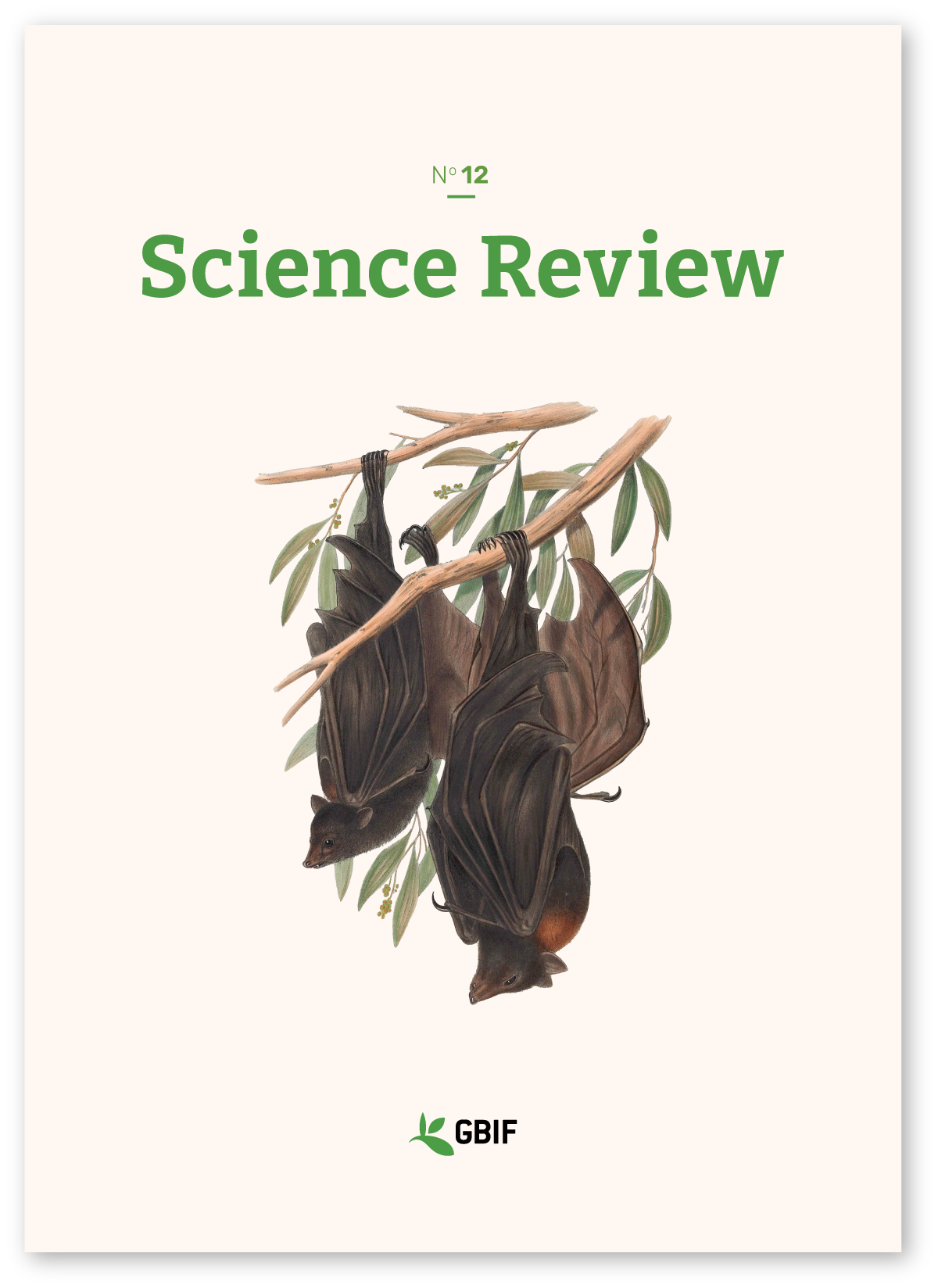
Science Review No. 12
Use of GBIF-mediated data in science continues to grow across both disciplines and geography. In the first three months of 2025, we logged an increase of 27 per cent in papers using data compared to the year before. In this Review, we are excited to share with you summaries of 50 studies that all make use of GBIF-mediated data in reaching their conclusions. Covering a wealth of topics, the selection of papers represents only a small fraction of the more than six papers discovered every single day of the year.
While the global COVID pandemic and subsequent lockdowns may seem like a past chapter for many, the One Health approach—with integrated research into animal and human diseases, their sources and vectors—remains more relevant than ever. Our feature section this year highlights 12 human health studies covering topics ranging from mercury poisoning from illegal gold mining—over zoonotic mpox and schistosomiasis—to a clinical study on inflammatory bowel disease.

Science Review No. 11
This compendium again offers a glimpse of the depth and extent of scientific research that the GBIF network supports every day. In 2023, the authors who rely on GBIF published an average of 34 peer-reviewed, GBIF-enabled papers each week. That rate makes it impossible for a curated selection of 50 summaries to be more than a fraction of the work, but we hope that together they highlight some of the most important, innovative and insightful articles from recent months.
So if the exercise of reading Science Review No.11 is taking parts to stand in for the whole, the same applies to the feature section that concludes the issue. GBIF-enabled research on the topic of climate change is never simply about biodiversity; instead, these papers reveal the range of researchers’ efforts to understand and reveal the complex and dynamic interplay between climate change and biodiversity.

Science Review No. 10
Inside this compendium, you’ll find new selection of 50 summaries of recent GBIF-enabled research. With almost five peer-reviewed papers published every day whose findings are based on data from the GBIF network, both you and our communications team has a wider range of examples to review and explore than ever.
Science Review No.10 also includes a feature section on research into invasive alien species (IAS), long one of the most frequent use cases for GBIF-mediated data. Watch this space, as they say: with the release of the latest IPBES thematic assessment on IAS this year, the GBIF community—including a new task group on invasives—will coordinate work to fill the data gaps it has identified.

Science Review 2021
Enclosed you’ll find summaries for 53 peer-reviewed articles published in 2020 that made substantive use of data from the GBIF network. These cross-disciplinary exemplars are only a fraction of the year’s nearly 1,000 such papers. Together they represent “the promising directions” highlighted by GBIF governing board chair Tanya Abrahamse in February 2021, upon publication of Mason Heberling’s review in the Proceedings of the National Academy of Sciences analysing more than 4,000 GBIF-enabled peer-reviewed articles.
The Science Review also introduces a feature section, this time focused on marine research, which cuts across several topics while highlighting our partnership with OBIS, the Ocean Biodiversity Information System. As always, we encourage you to visit GBIF.org, where you can keep track of the latest finds from our literature tracking programme.
Recent uses of GBIF-mediated data in policy documents and reports

Tides of Transparency: A First Mapping of Industrial Ocean Data Sharing
Report by the Ocean Data Action Coalition

The status of biological invasions and their management in South Africa in 2022
Report by the South African National Biodiversity Institute (SANBI)

Assessment of the suitability of the Finnish climate for Popillia japonica
Report by the Finnish Food Authority
Citation metrics

#CiteTheDOI
The number of peer-reviewed journal articles citing GBIF-mediated data has been steadily growing over the past 10 years. This graph illustrates the growth, also indicating the manner in which papers cite GBIF.
The gold standard and recommended practice for data citations includes a persistent identifier (a digital object identifier or DOI), which a narrow majority of GBIF users follow. GBIF works with authors, editors and publishers to improve the quality of data citations, enhancing reproducibility of scientific analyses and ensuring credit for data publishers.