
Checklist dataset Registered 24 October 2018
Systematic revision of the living African Slender-snouted Crocodiles (Mecistops Gray, 1844)
Published by Plazi.org taxonomic treatments database
Species
Mecistops cataphractus (Cuvier, 1824)
Classification and descendants
Loading
Loading
Loading
Loading
Loading
Loading
Media
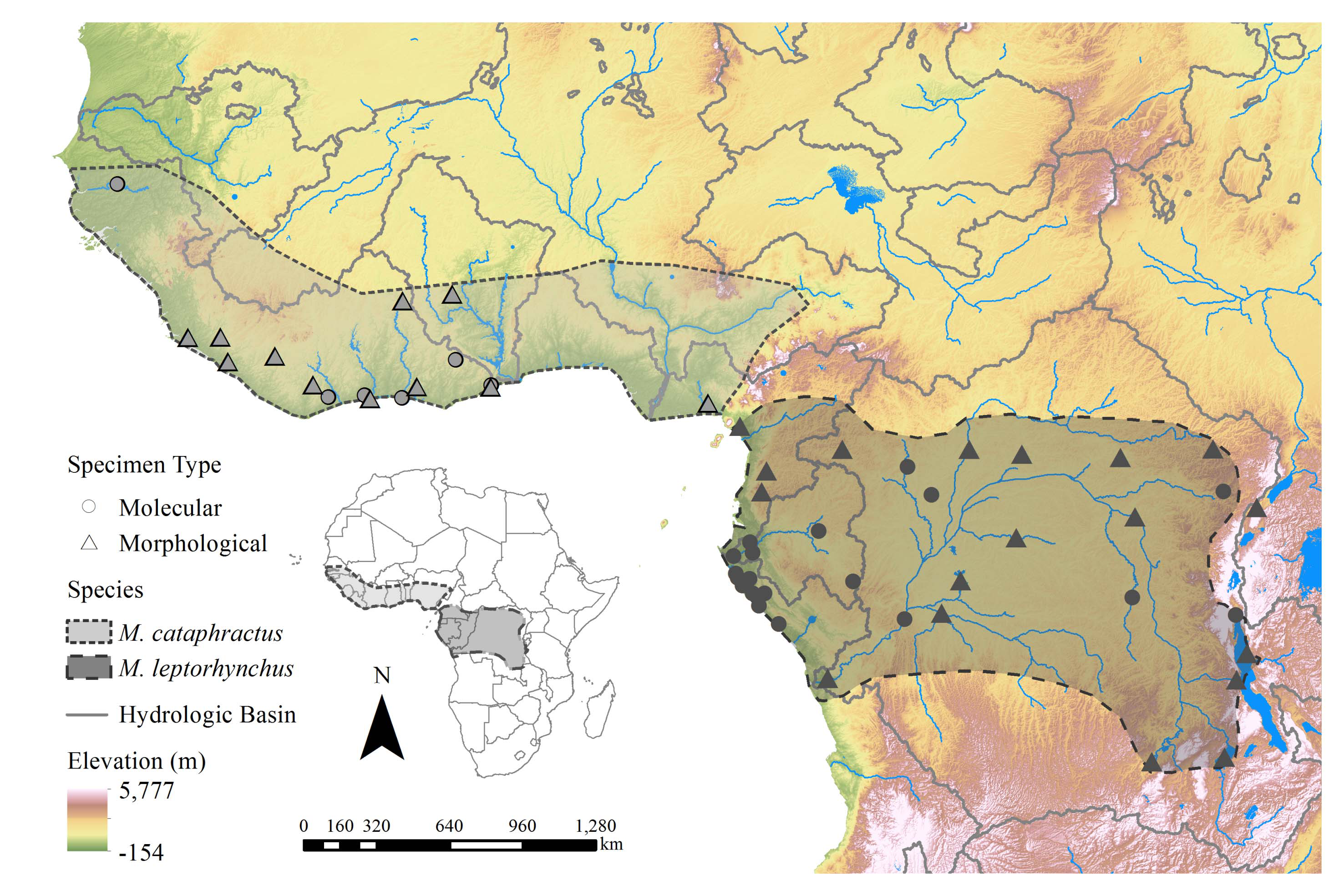
FIGURE 1. Map showing the distribution of Mecistops and its two content species: M. cataphractus and M. leptorhynchus.
Shirley, Matthew H.;Carr, Amanda N.;Nestler, Jennifer H.;Vliet, Kent A.;Brochu, Christopher A.
CC_BY

FIGURE 2. MCZ R-22483, neotype, Mecistops cataphractus. Photographic series showing dorsal, ventral, and lateral views of the skull, and overview of the mandibles. Photo credit: Museum of Comparative Zoology, Harvard University, ©President and Fellows of Harvard College.
Shirley, Matthew H.;Carr, Amanda N.;Nestler, Jennifer H.;Vliet, Kent A.;Brochu, Christopher A.
CC_BY
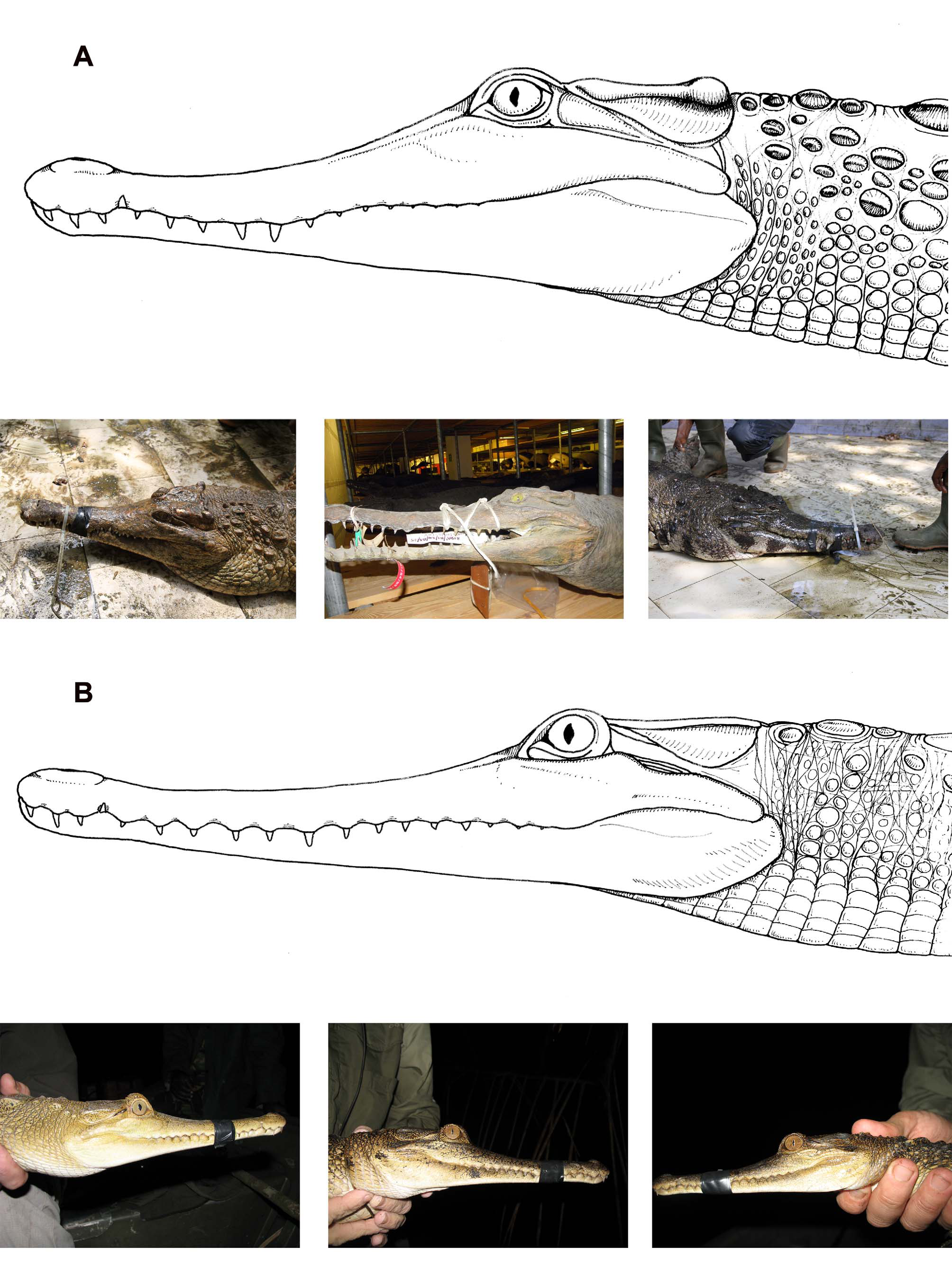
FIGURE 3. Squamosal boss or crest of Mecistops cataphractus (a) and its absence in M. leptorhynchus (b).
Shirley, Matthew H.;Carr, Amanda N.;Nestler, Jennifer H.;Vliet, Kent A.;Brochu, Christopher A.
CC_BY
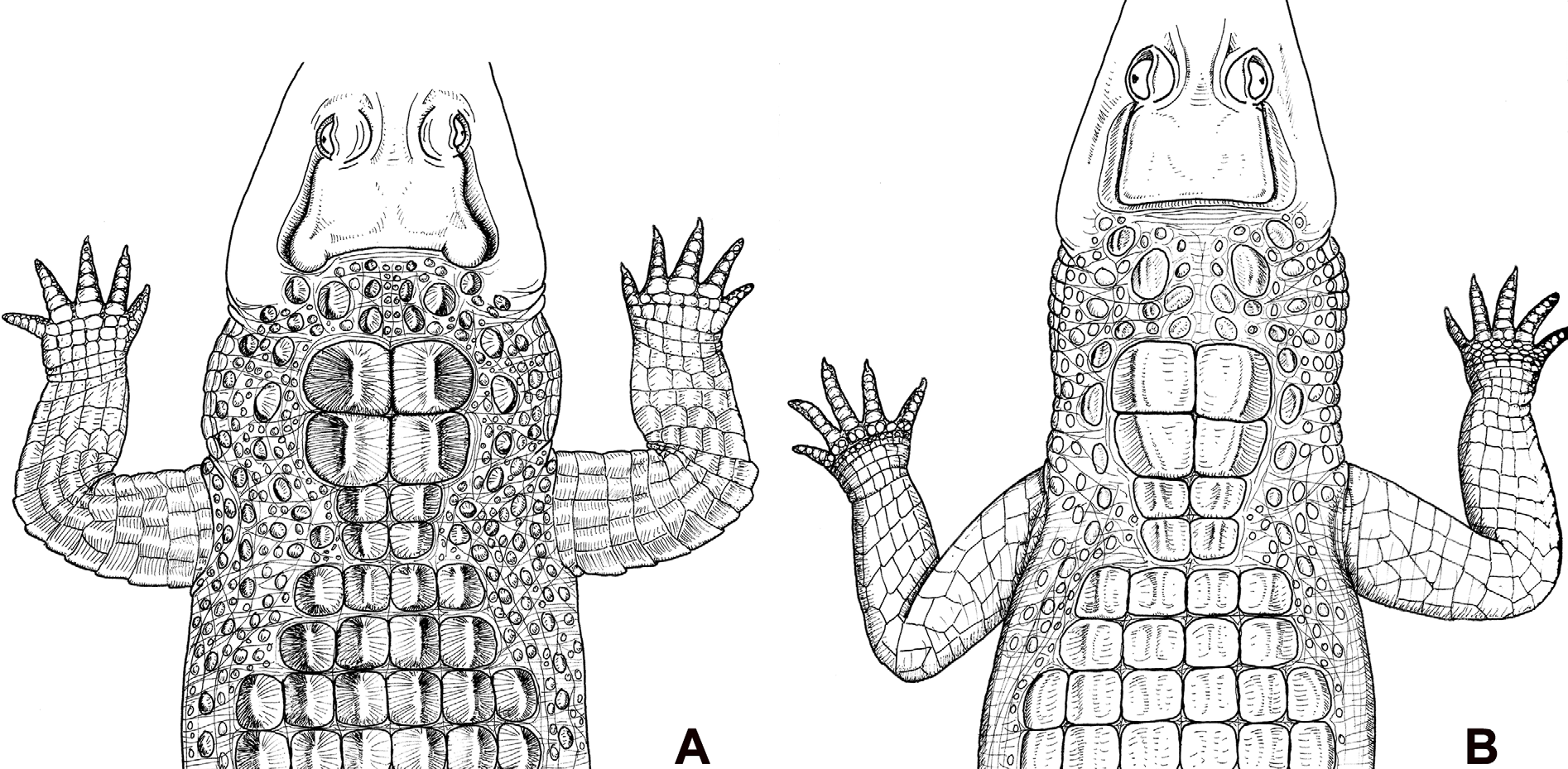
FIGURE 4. Typical nuchal scutellation in adult Mecistops cataphractus (a) and M. leptorhynchus (b). Note also the modest squamosal boss in M. cataphractus, which is absent in M. leptorhynchus.
Shirley, Matthew H.;Carr, Amanda N.;Nestler, Jennifer H.;Vliet, Kent A.;Brochu, Christopher A.
CC_BY

FIGURE 5. Typical flank scalation in adult Mecistops cataphractus (a) and M. leptorhynchus (b).
Shirley, Matthew H.;Carr, Amanda N.;Nestler, Jennifer H.;Vliet, Kent A.;Brochu, Christopher A.
CC_BY

FIGURE 6. Photographic series of M. cataphractus illustrating variation seen in the color and pattern throughout this species distribution. Left to right, top to bottom: dark colored juvenile showing burnt orange eye coloration from captive collection, USA (1-1); adult showing unpatterned, tan coloration of the Upper Guinea populations and illustrating very clearly the squamosal bosses typical of M. cataphractus from the Abidjan National Zoo, Côte d’Ivoire (1-2); highly blotched individual with the green/olive coloration from Silver Springs, Florida (1-3); highly blotched and banded adult with dark gold coloration from Silver Springs, Florida (2-1); a similarly patterned juvenile wild caught in Côte d’Ivoire formerly held at the Dipi Crocodile Farm (2-2); representative ventral coloration and pattern, most individual M. cataphractus show some level of dark blotching, St. Augustine Alligator Farm, Florida (2-3); melanistic individual wild caught in the Abi Lagoon, Côte d’Ivoire but captive held at the Parc Zoologique d’Assinie (3-1); yellow/gold colored individual illustrating the reduced jaw spotting of some individuals found in the Upper Guinea forests of Ghana and Côte d’Ivoire (3-2); dull/dark colored yearling, Subin River, Ghana (3-3); typically colored and patterned animals from the Senegambia area illustrating the dark gold background color and heavy black blotching, jaw spots, and overall dark patterning from the Gambia River, River Gambia National Park, The Gambia (row 4).
Shirley, Matthew H.;Carr, Amanda N.;Nestler, Jennifer H.;Vliet, Kent A.;Brochu, Christopher A.
CC_BY
Bibliography
1 result
Cuvier, G. L. (1824) Recherches Sur Les Ossemens Fossiles. Vol. 5. 2 eme. G. Dufour & E. d'Ocagne Libraries, Paris, 185 pp. |
Citation
Loading
Loading