
Checklist dataset Registered 3 October 2020
Widespread polytypic species or complexes of local species? Revising bumblebees of the subgenus Melanobombus world-wide (Hymenoptera, Apidae, Bombus)
Published by European Journal of Taxonomy
Species
Bombus lapidarius (Linnaeus, 1758)
Classification and descendants
Loading
Loading
Loading
Loading
Loading
Loading
Synonyms and combinations
14 results
- = Apis audens Harris, 1776
- = Apis coronata Geoffroy in Fourcroy, 1785
- = Apis lapidaria Linnaeus, 1758
- = Apis opis Harris, 1776
- = Apis pertristis Harris, 1776
- = Apis strenuus Harris, 1776
- = Bombus albicans Schmiedeknecht, 1878
- = Bombus bisiculus Lecocq, Biella, Martinet & Rasmont, 2019
- = Bombus flavescens Knechtel, 1963
- = Bombus lapidarium (Linnaeus, 1758)
Media

Figs 14‒16. Maps of sequenced samples as in Figs 12–13. 14. The tanguticus-group and the lapidarius- group. 15. The sichelii-group. 16. The keriensis-group.
Williams, Paul H.;Altanchimeg, Dorjsuren;Byvaltsev, Alexandr;Jonghe, Roland De;Jaffar, Saleem;Japoshvili, George;Kahono, Sih;Liang, Huan;Mei, Maurizio;Monfared, Alireza;Nidup, Tshering;Raina, Rifat;Ren, Zongxin;Thanoosing, Chawatat;Zhao, Yanhui;Orr, Michael C.
CC_BY
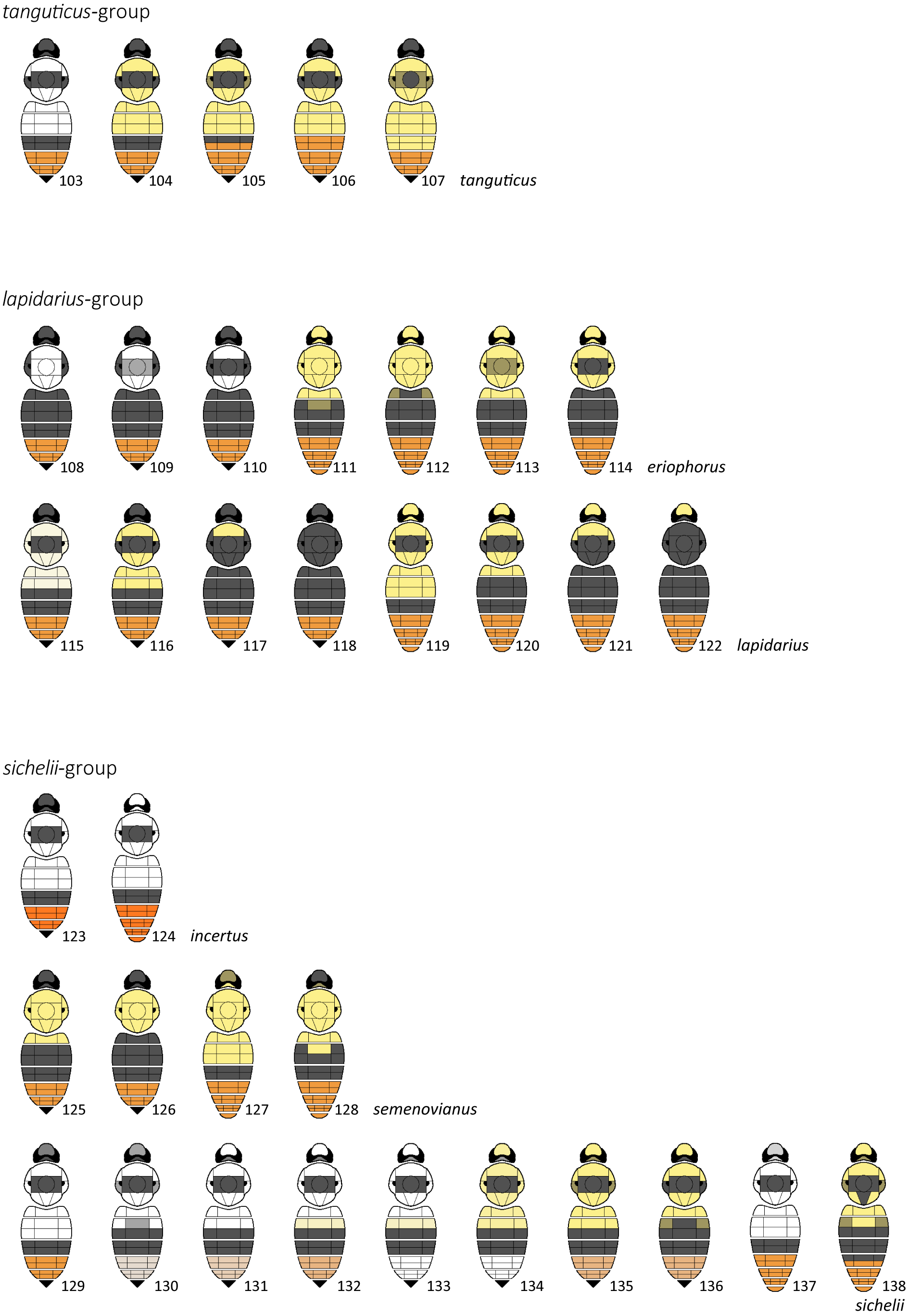
Figs 103–138. Simplified diagrams for the colour patterns of the hair on the dorsum for the species from the integrative analysis. The dorsum is divided into regions, each of which shows only the predominant or most apparent colour for that region using a simplified colour palette, with olive indicating a mixture of black and yellow hair, and grey indicating a mixture of black and white hair. The tanguticus-group. 103. Worker, China-Qinghai. 104. Worker, China-Qinghai. 105. Queen, China-Qinghai. 106. Queen, China-Xizang. 107. Queen, India-Kashmir. The lapidarius-group. 108. Queen, Russia-North Ossetia. 109. Worker, Azerbaijan. 110. Queen, Georgia. 111. Male, Russia-North Ossetia. 112. Male, Russia-North Ossetia. 113. Male, Russia-North Ossetia. 114. Male, Turkey. 115. Queen, Morocco. 116. Queen, Spain. 117. Queen, Spain. 118. Queen, UK. 119. Male, Spain. 120. Male, Spain. 121. Male, UK. 122. Male, UK. The sichelii-group. 123. Queen, Iran. 124. Male, Iran. 125. Queen, India-Kashmir. 126. Queen, India- Kashmir. 127. Male, India-Kashmir. 128. Male, India-Kashmir. 129. Queen, Iran. 130. Queen, Russia- Sakha. 131. Queen, China-Sichuan. 132. Worker, China-Sichuan. 133. Queen, Mongolia. 134. Worker, Mongolia. 135. Queen, Spain. 136. Worker, Austria. 137. Male, Turkey. 138. Male, Mongolia.
Williams, Paul H.;Altanchimeg, Dorjsuren;Byvaltsev, Alexandr;Jonghe, Roland De;Jaffar, Saleem;Japoshvili, George;Kahono, Sih;Liang, Huan;Mei, Maurizio;Monfared, Alireza;Nidup, Tshering;Raina, Rifat;Ren, Zongxin;Thanoosing, Chawatat;Zhao, Yanhui;Orr, Michael C.
CC_BY
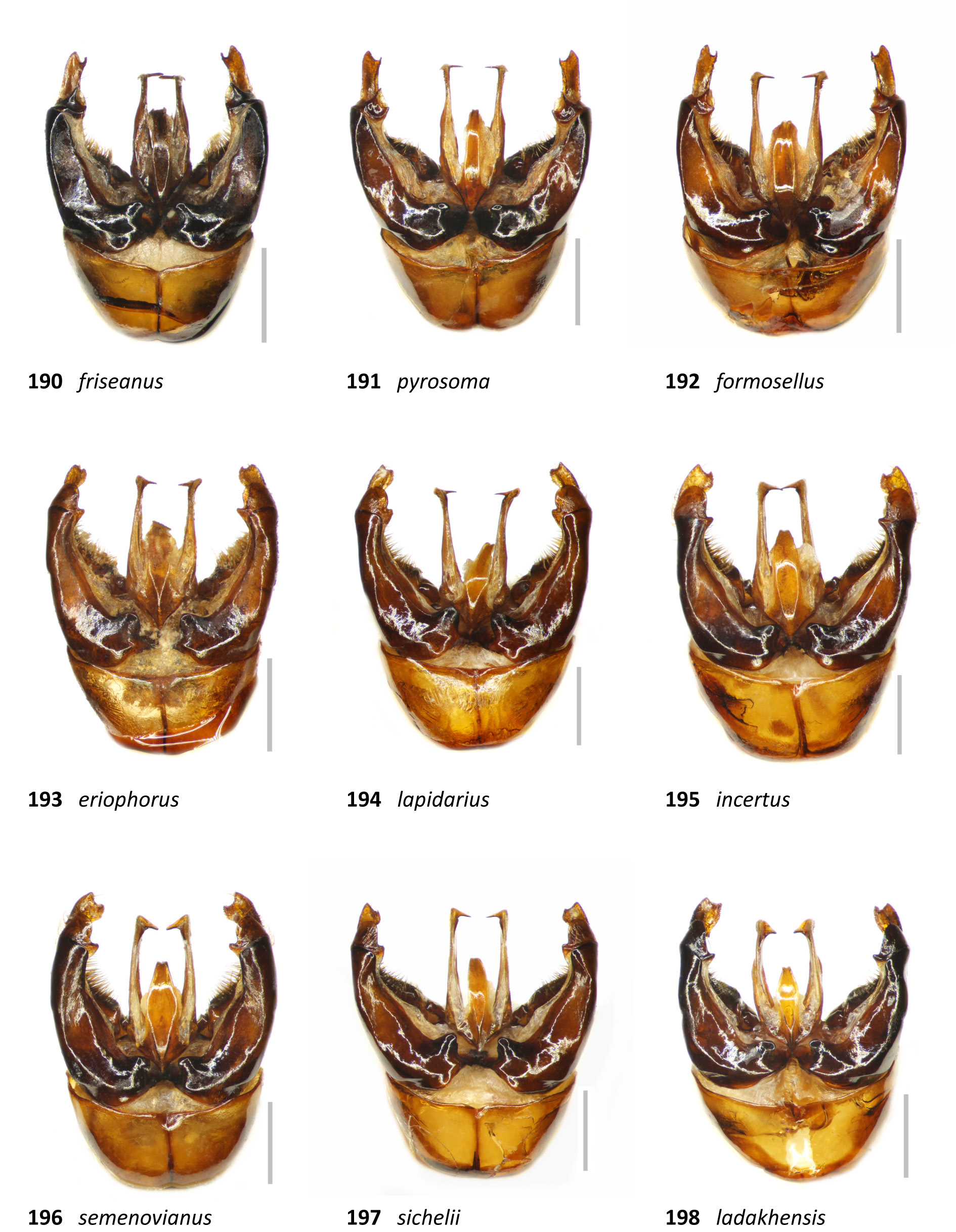
Figs 190‒198. Morphology of the male genitalia for species of the subgenus Melanobombus von Dalla Torre, 1880 from the dorsal aspect, anterior at the bottom of the image, posterior at the top. 190. Bombus friseanus Skorikov, 1933, China-Yunnan. 191. B pyrosoma Morawitz, 1890, China- Beijing. 192. B. formosellus (Frison, 1934), China-Taiwan. 193. B. eriophorus Klug, 1807, Russia- North Ossetia. 194. B. lapidarius (Linnaeus, 1758), UK. 195. B. incertus Morawitz, 1881, Turkey. 196. B. semenoviaus (Skorikov, 1914), India-Kashmir. 197. B. sichelii Radoszkowski, 1859, Austria. 198. B. ladakhensis Richards, 1928, China-Sichuan. Scale bars = 1 mm.
Williams, Paul H.;Altanchimeg, Dorjsuren;Byvaltsev, Alexandr;Jonghe, Roland De;Jaffar, Saleem;Japoshvili, George;Kahono, Sih;Liang, Huan;Mei, Maurizio;Monfared, Alireza;Nidup, Tshering;Raina, Rifat;Ren, Zongxin;Thanoosing, Chawatat;Zhao, Yanhui;Orr, Michael C.
CC_BY
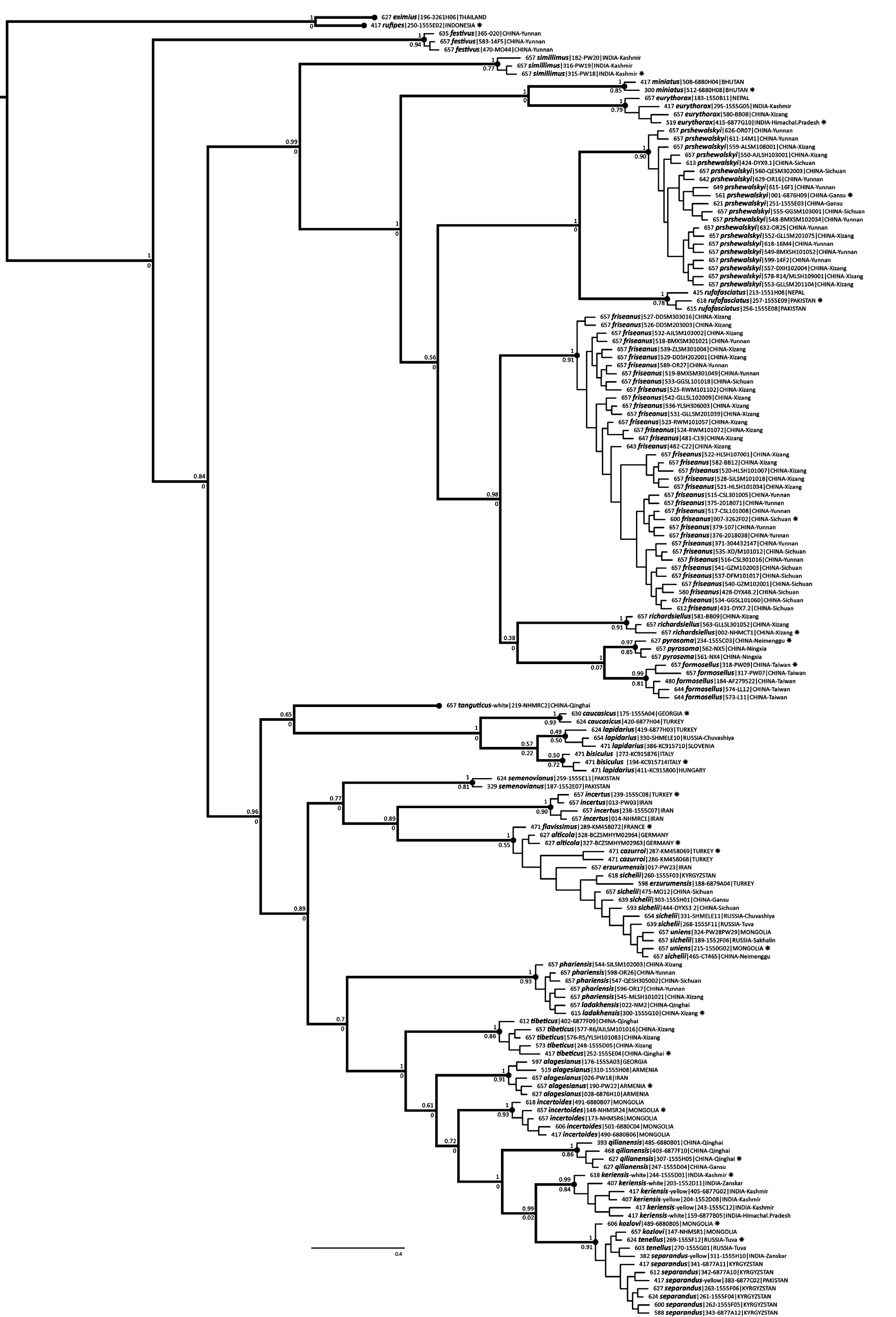
Fig. 10. October 2019 (Fig. 8) Bayesian PTP analysis of MrBayes tree of unique COI barcodes (UHF- PTP). Symbols as in Fig. 9.
Williams, Paul H.;Altanchimeg, Dorjsuren;Byvaltsev, Alexandr;Jonghe, Roland De;Jaffar, Saleem;Japoshvili, George;Kahono, Sih;Liang, Huan;Mei, Maurizio;Monfared, Alireza;Nidup, Tshering;Raina, Rifat;Ren, Zongxin;Thanoosing, Chawatat;Zhao, Yanhui;Orr, Michael C.
CC_BY
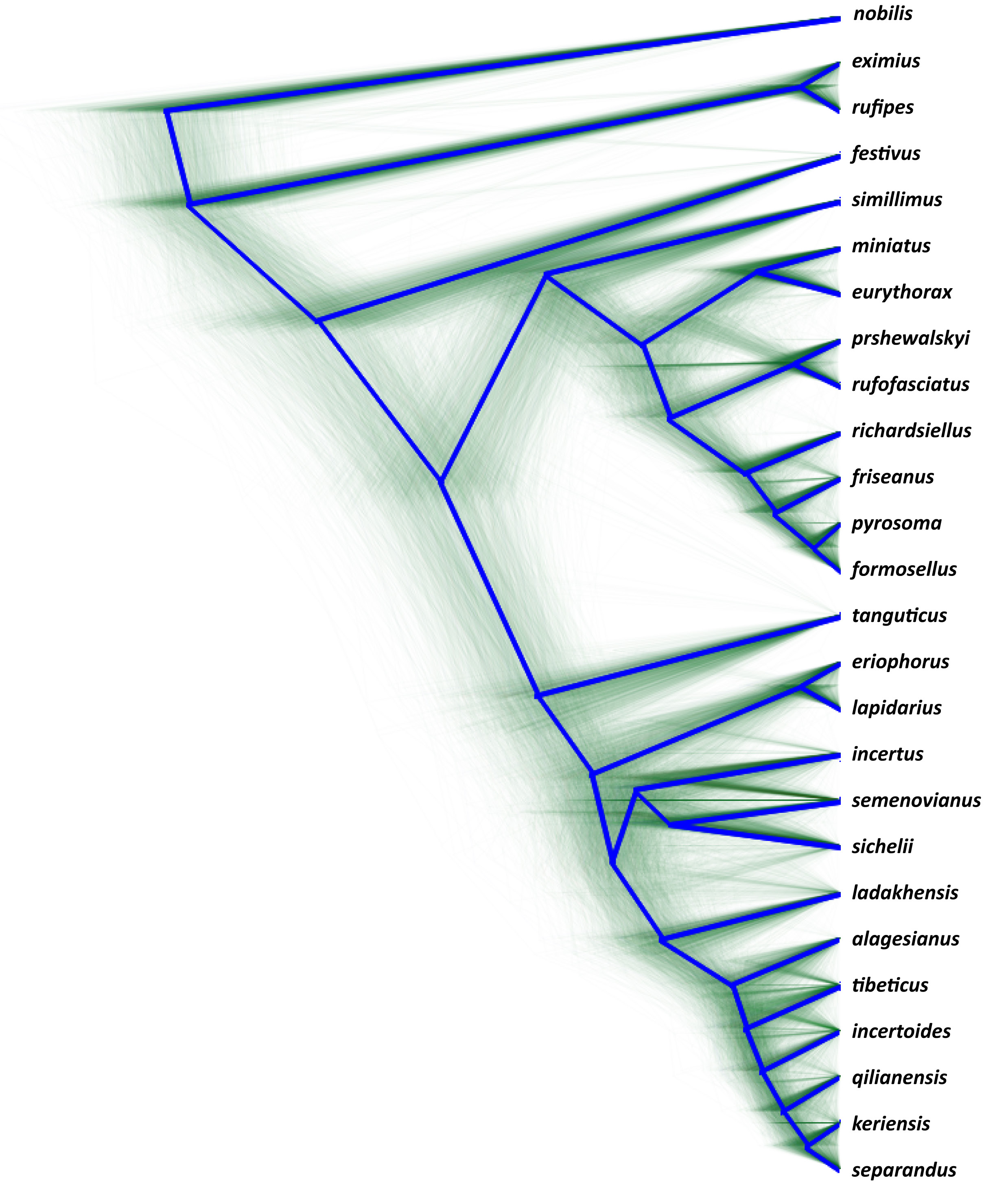
Fig. 21. A sample of 10 000 species trees from among 100 million trees for species of the subgenus Melanobombus von Dalla Torre, 1880 reconstructed with *BEAST from gene trees for the COI, 16S, opsin and PEPCK genes, displayed in green using Densitree, with the summary ‘root canal’ superimposed as a thick blue line. The outgroup B. nobilis Friese, 1905 is shown.
Williams, Paul H.;Altanchimeg, Dorjsuren;Byvaltsev, Alexandr;Jonghe, Roland De;Jaffar, Saleem;Japoshvili, George;Kahono, Sih;Liang, Huan;Mei, Maurizio;Monfared, Alireza;Nidup, Tshering;Raina, Rifat;Ren, Zongxin;Thanoosing, Chawatat;Zhao, Yanhui;Orr, Michael C.
CC_BY
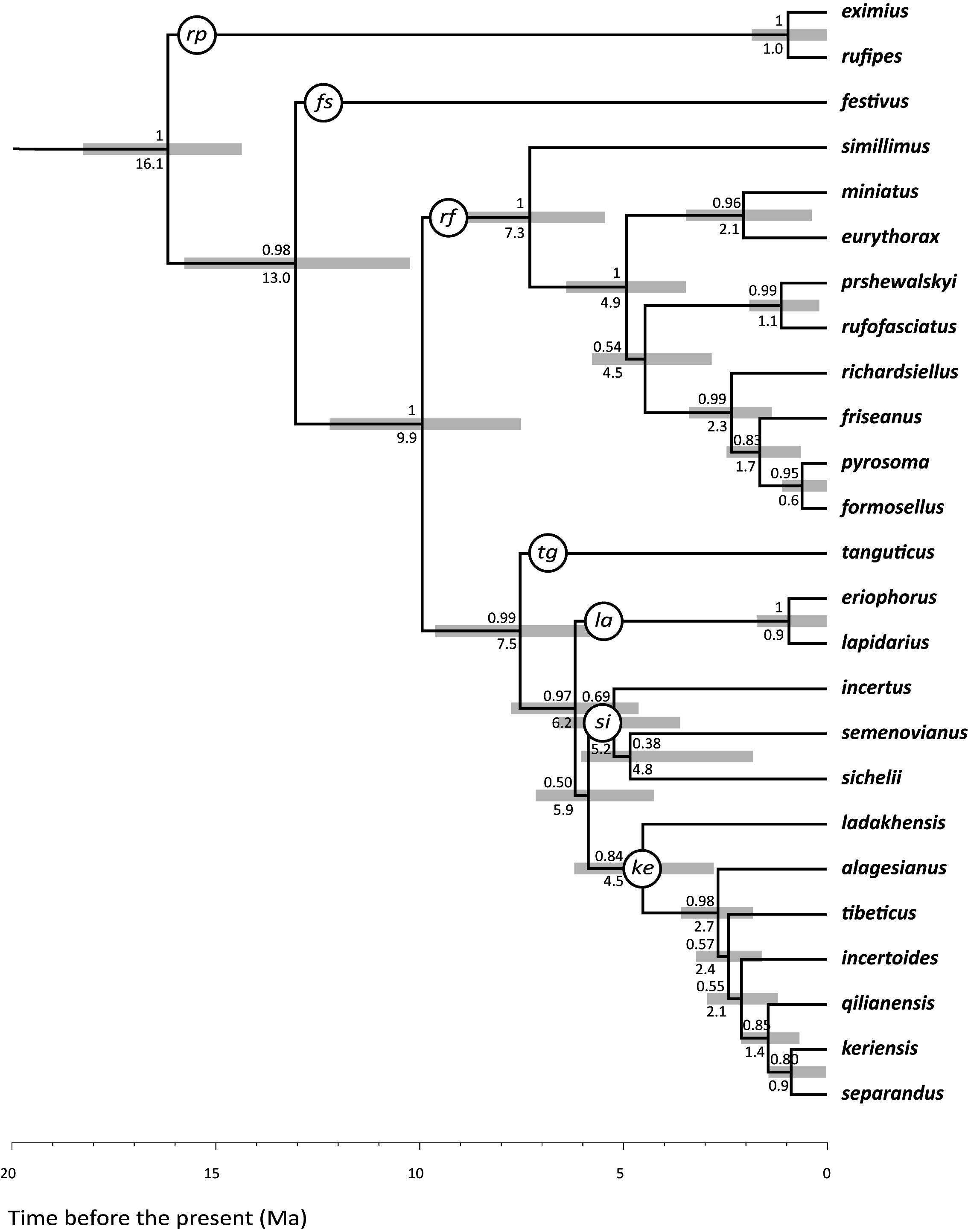
Fig. 22. Most likely dated phylogenetic (ultrametric) tree for the species of the subgenus Melanobombus reconstructed von Dalla Torre, 1880 with *BEAST from trees for four genes (COI, 16S, PEPCK, opsin) with B. nobilis Friese, 1905 as the outgroup (not shown), estimated as the maximum-clade-credibility tree among a sample of 10 000 species trees with a 1% burn-in out of 100 million MCMC trees. Values above the nodes are Bayesian posterior probabilities showing support for groups. Values below the nodes are estimated dates of divergence in Ma (millions of years before the present) calibrated from a molecular estimate for the date of crown divergence within the subgenus Melanobombus. Grey bars show the 95% confidence limits on the estimated dates of divergence. Species groups discussed in the text are labelled in circles: rp = rufipes-group; fs = festivus-group; rf = rufofasciatus-group; tg = tanguticus-group; la = lapidarius-group; si = sichelii-group; and ke = keriensis-group.
Williams, Paul H.;Altanchimeg, Dorjsuren;Byvaltsev, Alexandr;Jonghe, Roland De;Jaffar, Saleem;Japoshvili, George;Kahono, Sih;Liang, Huan;Mei, Maurizio;Monfared, Alireza;Nidup, Tshering;Raina, Rifat;Ren, Zongxin;Thanoosing, Chawatat;Zhao, Yanhui;Orr, Michael C.
CC_BY
Bibliography
10 results
Fourcroy A. F. d. 1785. Entomologia Parisiensis; sive Catalogus Insectorum quae in agro Parisiensi reperiuntur; secundum methodum Geoffraeanam in sectiones, genera & species distributus: cui addita sunt nomina trivialia & fere trecentae novae species. Paris. https: // doi. org / 10.5962 / bhl. title. 36528 |
Harris M. 1776. An Exposition of English Insects, with Curious Observations and Remarks, wherein each Insect is particularly described; its Parts and Properties considered; the different Sexes distinguished, and the natural History faithfully related. London. https: // doi. org / 10.5962 / bhl. title. 122956 |
Panzer G. W. F. 1805. Faunae Insectorum Germanicae initia oder Deutschlands Insecten gesammelt und herausgegeben. N ʾ rnberg. https: // doi. org / 10.5962 / bhl. title. 15007 |
Ball F. J. 1920. Notes supplementaires sur les bourdons de la Belgique. Annales de la Societe entomologique de Belgique 60: 31 - 43. |
Schmiedeknecht H. L. O. 1878. Monographie der in Th ʾ ringen vorkommenden Arten der Hymenopteren- Gattung Bombus mit einer allgemeinen Einleitung in dieses Genus. Jenaische Zeitschrift fur Naturwissenschaft 12: 303 - 430. |
Lecocq T., Biella P., Martinet B. & Rasmont P. 2019. Too strict or too loose? Integrative taxonomic assessment of Bombus lapidarius complex (Hymenoptera: Apidae). Zoologica Scripta 49: 187 - 196. https: // doi. org / 10.1111 / zsc. 12402 |
Knechtel W. K. 1963. Bombine din imprejurimile Lacului Petea (reg. Crisana). Communicarile Academiei Republicii Populare Romine 13: 711 - 715. |
Berezin M. V., Beiko V. B. & Berezina N. V. 1996. Analysis of structural changes in the bumblebee (Bombus, Apidae) population of Moscow Oblast over the last forty years. Entomological Review 76: 115 - 123 |
Linnaeus C. 1758. Systema Naturae per Regna Tria Naturae, Secundum Classes, Ordines, Genera, Species, cum Characteribus, Differentiis, Synonymis, Locis, Editio Decima, Reformata. Laurentii Salvii, Stockholm [Holmiae]. https: // doi. org / 10.5962 / bhl. title. 542 |
Friese H. 1905. Neue oder wenig bekannte Hummeln des russischen Reiches (Hymenoptera). Ezhegodnik Zoologicheskago muzeya 9: 507 - 523. |
Citation
Bombus lapidarius (Linnaeus, 1758) in undefined